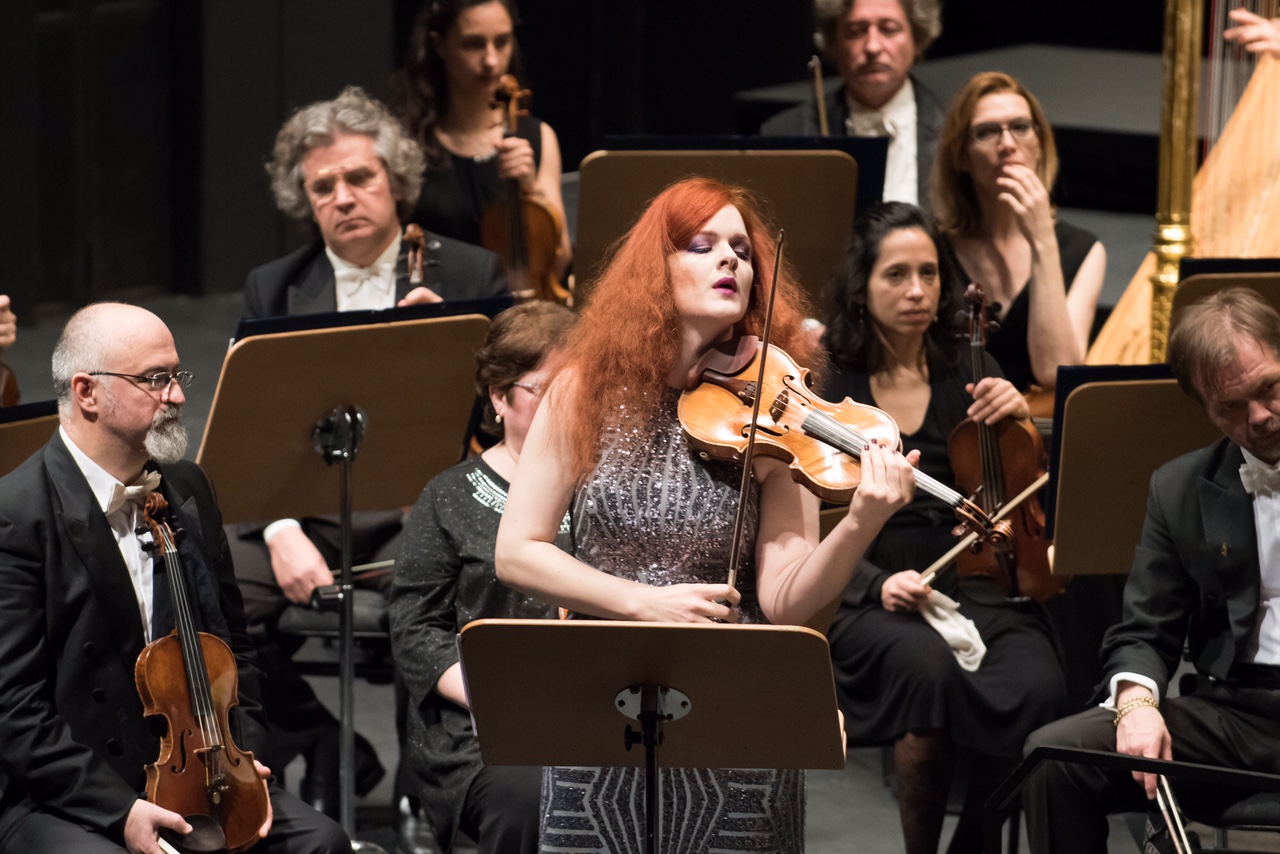
• 01 JUN 2026 - Review - Music Web International - Nick Barnard - "This is a triumph from first to last."
Ladies First Rachel Kolly (violin), Pallavi Mahidhara (piano) rec. June 2025, Salle de musique, La Chaux-de-Fonds, Switzerland IndéSENS Calliope IC108 [72]
/ Read this review online
"The calibre of the music and the performances on this disc are what matters now, and by that measure this is a triumph from first to last."
I do not have an encyclopaedic knowledge of violinist Rachel Kolly’s discography but I have enjoyed all of her recordings that I have heard. So, I was very interested to hear this well-planned and quite unusual programme of music by female composers. None of the works are new to the catalogue but their programming together is unique. The music spans some seven decades, from Clara Schumann’s Three Romances for Violin and Pianoof 1855 to Rebecca Clarke’s Midsummer Moon written in 1926.
My personal feeling is that by 2026 it has become possible to move beyond the narrative of “lost music” composed by marginalised women. I am not sure the title “Ladies First” chosen for this collection is quite as wholly affirmative as the label’s A&R department intended. Perhaps even fifteen years ago it could be argued that many if not all of the composers here were unfairly lost in the shadows of male contemporaries – but the quality of the music has triumphed. Whatever the injustices of the past, in today’s musical climate this music can be appreciated and measured by the highest musical standards.
The programme begins with – for me – a fine discovery: Swedish composer Amanda Röntgen-Maier’s boldly confident Violin Sonata in B minor. I had not heard her music before, but the catalogue reveals several versions of pretty much all of her small oeuvre, culminating in a 2019 three-disc release on the Swedish label dB Productions titled Complete Works. Maier was the first female to graduate (in 1873) with the title Musikdirektör from the Royal College of Music in Stockholm. She continued her studies in Leipzig: violin with Engelbert Röntgen and composition with Carl Reinecke. It was then that she wrote her only orchestral work, a seventeen-minute Violin Concerto. She married her violin teacher’s son, composer Julius Röntgen, in 1880; that ended her concertising but not her composing career.
Röntgen-Maier’s German training makes it no surprise that the violin sonata, which she also wrote during her studies, is full of Germanic rather than Nordic influences. The work in the standard three movements runs to a powerful but compact twenty minutes in this performance. My first thought was of a slightly febrile Brahms, with the shades of Schumann and Mendelssohn nodding approvingly in the background. But that is to do her a disservice. Her musical voice does appear with assurance and confidence. It is interesting to note that, while her personal expertise on the violin guarantees effective if quite demanding writing for that instrument, she ensures that the piano too is given a significant rather than simply accompanying role.
Rachel Kolly is very impressive throughout this work. She plays with an elegant, light yet focussed tone which suits this music very well. I like the way she deploys the occasional little expressive portamento. Nothing is forced, and she intelligently avoids over-dramatising any of the works on this disc. But equal credit must go to her colleague Pallavi Mahidhara on piano. She is clearly a kindred musical spirit to Kolly, equally elegant and fluent, with technique to spare and power in reserve as the music demands. Engineer Florian B. Schmidt has created for the players a supportive but not too close sound stage, and the balance between the two instruments is very well controlled. The central Andantino, in contrast to the outer fast movements, is more a song without words; it showcases perfectly both Kolly’s floated tone and the subtle nuances of Mahidhara’s accompaniment.
The score of the sonata can be found on IMSLP. A recent critical edition there has a useful note: “This award-winning Sonata was published in 1878 by the Musical Concert Society in Stockholm. In a letter dated July 13 1874, the composer herself describes the sonata as ‘a little wild’, whilst pointing out that if it is performed well it sounds ‘not bad, as anything I have heard and done in Leipzig’.” After I have discovered the work here, I sought out the performance from that dB Productions box. The violinist there, Cecilia Zilliacus, is also a fine player but with a more rugged approach than Kolly, perhaps referencing Maier’s own “wild” comment. At a push, I find Kolly’s sheer poise irresistible.
This quality of playing suits much of the following programme too. Mel Bonis is certainly in the middle of a major re-evaluation which has recently resulted in two identical surveys of her complete orchestral works on major labels. The first time I reviewed her music was in 2019; the stand-out works were her piece and two featured here by the genius that was Lili Boulanger. Just seven years ago, Bonis’s music on disc was a genuine rarity. Jump forward to late 2023: I reviewed a double disc that included the Allegretto non troppo included here. To my ear, this is the kind of work and scale of composition where Bonis’s real strength and unique musical voice lie. I have enjoyed the orchestral works too, but in performances such as Kolly’s this Allegretto is elevated to the status of gem-like perfection. Her fast, slightly fluttering vibrato seems ideally suited.
Bonis’s career as a composer was circumscribed by her personal life but of all the composers represented here probably Clara Schumann was the one who sacrificed most on a personal artistic level. The liner notes contain quotes which include her writing “there is nothing greater than the joy of composing” – not that husband Robert helped. He wrote “Clara knows that being a mother is her main mission”, a somewhat self-serving comment since it freed him to compose, and left Clara to run the household and look after eight children. Clearly composition remained a refuge: she managed to find time and the creative energy to write music every year from the age of 11 to 29 (she married Schumann when she was turning 21).
A meeting with Brahms in 1853 stimulated a burst of creativity: some sixteen works, including Three Romances for Violin and Piano recorded here. As with Röntgen-Maier’s piece, the result is compelling music that echoes the influence of Brahms amongst others while creating an individual and deeply personal work. The piece was dedicated to Joseph Joachim, with whom Clara Schumann toured them after her husband’s death. Although written as three individual pieces, they make an impressive set and are usually recorded as such. Isata Kanneh-Mason was joined by Elena Urioste on her Decca disc devoted primarily to the piano music of Clara Schumann. That is also a fine performance but I think Kolly and Mahidhara find slightly greater capricious range and lithe elegance overall.
Amy Beach’s music is likewise receiving greater attention. Her struggle was the faint disdain which upper middle-class society felt about earning money from music. She remained childless, and her husband – a wealthy Boston surgeon – was able to give her the financial stability and personal time Clara Schumann could only dream of, although composing and performing were for domestic rather than public consumption. The Romanceplayed here is an impassioned work but somehow more generic in its writing for both instruments and also in the musical vernacular it employs. For sure, it receives another compelling and highly effective performance here, but it is not of the same stature as much of the other music on the disc.
Dora Pejačević has also experienced a considerable uptick in recordings and wider awareness, though the enterprising cpo label recorded her Violin Sonata No.2as long ago as 2008. (I heard neither that performance not two others listed on the Presto website.) My knowledge of Pejačević’s quite extensive catalogue is limited to her orchestral music; the big and impressive Symphony in F sharp minorstands out. The sonata has a date similar to the symphony’s original version, so there is no surprise that it also shares a sweepingly powerful expressive intent albeit on a more compact scale. The booklet cannot quite agree with itself if it was written in 1917 (quoted in the main text) or 1919 (in the track listing); online search suggests 1917.
The notes explain the ‘Slavic’ title thus: “[…] one of the first works of Croatian music that belong to the national style. There is a clear attempt to integrate folklore into a personal musical language.” This is more apparent in the central Andantino where melodic shapes have a folksong-like flavour. The stormy opening Allegro is more a turbulent, passionate movement firmly rooted in 19th-century traditions rather than anything more musically adventurous. The closing Allegro molto vivace also has characteristics of a stamping folk-dance. Yet the notes say that the folk elements are wholly absorbed and can be heard as influences rather than a wish to recreate them for the concert hall. Wholly appropriately for the music, Kolly and Mahidhara play this work with notably greater weight and attack. Of course, there is wide expressive range as the music dictates but this is audibly more “into the string” than elsewhere in this programme.
The two Boulanger sisters never struggled for acceptance in the musical world like several of the other composers represented here did. Younger sister Lili was acknowledged as a genius from her Prix de Rome winning days on. Her older sister Nadia – more famous as a teacher of other composers rather than a composer herself – ensured that Lily’s reputation lasted long after her much-too-early death at the age of 25.
The two pieces by Lili Boulanger, Nocturne and Cortège, were my introduction to her music. The former was an Associated Board Grade V piece back in the 1970s. It was a revelation to me then and remains so to this day. Yehudi Menuhin and Clifford Curzon recorded them for EMI in 1967. I far prefer Kolly’s gossamer tone in both works, but in fact the daringly slow tempo Menuhin and Curzon adopt for the Nocturne gives this extraordinary work an additional level of pensive intensity that is undoubtedly powerful. Both performances of Cortège are at a similar tempo, although Mahidhara’s accompaniment ‘bubbles’ more than the slightly reticent Curzon’s. This is the one time I do not find Kolly’s portamenti to be so effective.
Nadia Boulanger’s offering is Kolly’s transcription of a 1907 song, a Verlaine setting. Tenor Nicholas Phan recorded the original for Avie in 2019. It works remarkably well in both versions. The presence of the text makes the intention of the song instantly clearer: “A fading dawn pours across the fields, the melancholy of the setting sun. With sweet songs the melancholy rocks my heart forgetting itself with the setting sun.” Nadia was in her late teens when she wrote the song. It shows a real skill in the minimalist use of musical gesture for maximum effect, something Lili would also excel at. Kolly and Mahidhara skillfully emphasise this sparseness of texture with a performance of daring simplicity and expressive control – this is just gorgeous.
Rebecca Clarke’s Midsummer Moon completes the programme. Hannah Roper played this on an interesting Albion disc “Romance and Reverie: Holst and his contemporaries”; it was probably the most interesting work in a somewhat uneven programme. This is a genuinely attractive work that unsurprisingly gets a very impressive performance here. (Lorraine McAslan also recorded it for Dutton on a disc of Clarke’s chamber works that I have not heard.) This touchingly moving and thoughtful work hovers between impressionism and pastoralism in a way that I really enjoy.
I am not quite sure that I can subscribe to the claims in the liner notes that Clarke is, quoting Liane Curtis, “one of the most important composers in the United Kingdom between the two World Wars” – or to Stephen Banfield’s comment about “the most remarkable British composer of the interwar period”. None of the music or composers represented on this disc requires such sweeping claims on their behalf to tell the listener what their ears can already hear. All of the works here are of real and lasting quality but nothing can be done about prior neglect or societal marginalisation. The calibre of the music and the performances on this disc are what matters now, and by that measure this is a triumph from first to last.
Nick Barnard